
MUD TESTING EQUIPMENT
For years, Inmotion Energy has supplied
precision instruments and drilling tools for
testing drilling fluids, well cements, and
completion fluids.
From our Bangalore facility, we provide
customers across India and the Middle East
with quality products and exceptional
service.
INDUSTRIES WE SERVE
— Onshore & offshore drilling contractors
— National & independent oil companies
— Mud engineering & testing laboratories
— Well completion & workover operations
WHY CHOOSE US
— Rigorous quality control on every unit
— Fast turnaround on spares &
replacements
— Field-tested designs, built for uptime
INMOTION ENERGY (OPC) PRIVATE LIMITED
- 186, 1st Main Road, Vijaya Bank Layout, Bilekahalli, Bangalore, Karnataka – 560076
- Phone: +91 96637 44619
- info@inmotionenergy.in
- imotion.in
PRODUCT SPECIFICATION — Methylene Blue Test Kit (MBT)
Model: IM-MBT-RMBT Compliance / target standard: API RP 13B-1 Sec. 10
Methylene Blue Test Kit (MBT)
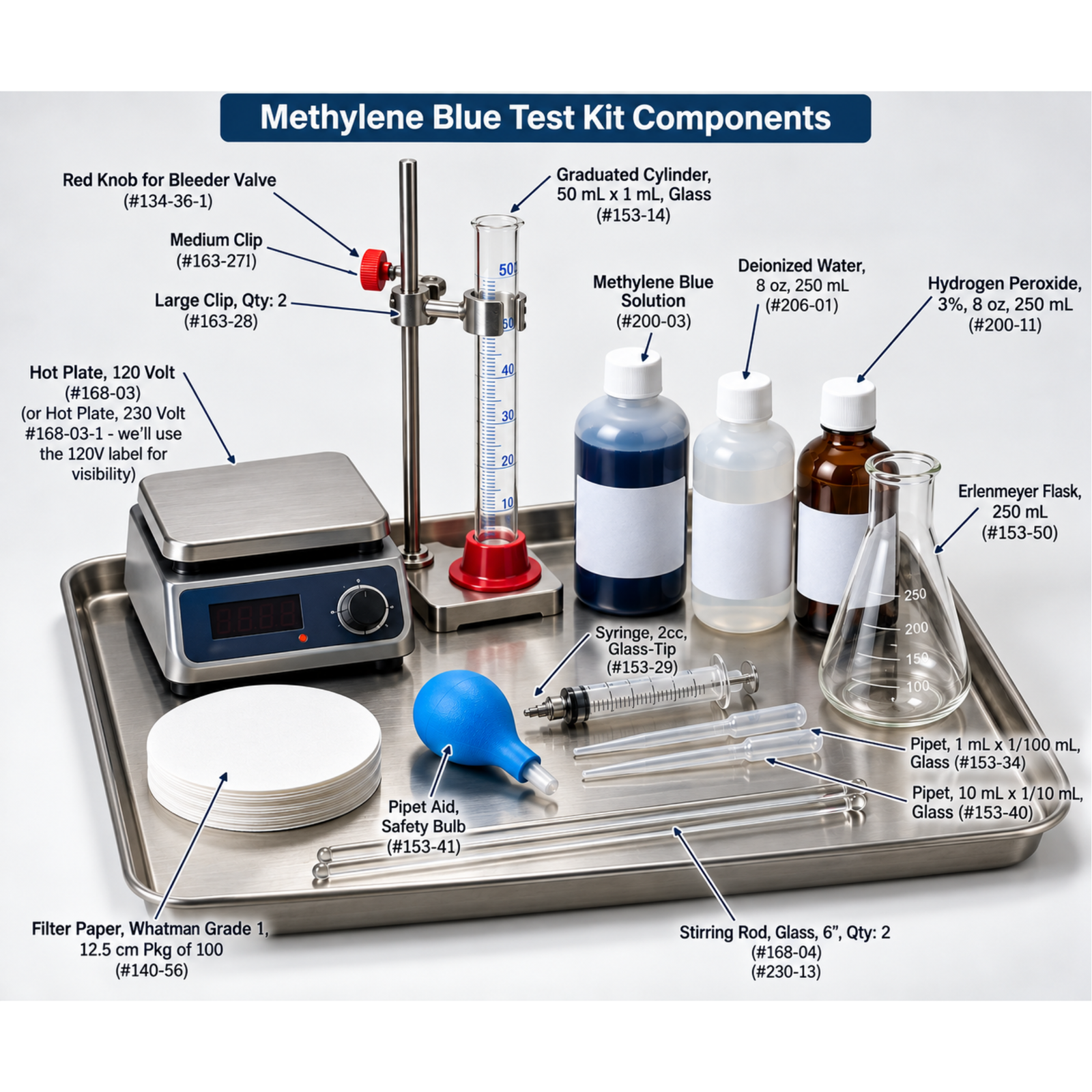
Figure 9. Reference photograph of the Methylene Blue Test Kit (MBT) with labeled components and Inmotion part numbers. Components are listed on page 2.
Intended applications
• Estimating reactive-clay (bentonite-equivalent) content of water-based mud.
• Tracking build-up of low-gravity reactive solids and drilled shale.
• Deciding on dilution or solids-control action.
• Screening clays and shales by cation exchange capacity.
FEATURES
• Standard 0.01 meq/mL methylene blue solution in a dropper bottle.
• Reagents for oxidation of organics: hydrogen peroxide (3 %) and dilute sulfuric acid.
• Erlenmeyer flask, syringe, pipettes and stirring rod.
• Filter paper for spot testing.
• Portable case for laboratory or rig use.
TECHNICAL SPECIFICATIONS
| Titrant | Methylene blue, 0.01 meq/mL (about 3.74 g/L as trihydrate) |
| Mud Sample | Typically 2 mL (water-based mud) |
| Pre-treatment | 10 mL water, 15 mL 3 % H2O2, 0.5 mL 5 N H2SO4, boil gently 10 min |
| Titration Increment | 0.5 mL of methylene blue solution |
| End Point | Light blue halo around the dyed solids spot on filter paper |
| Result | MBC = mL methylene blue / mL mud (meq/mL) |
| Bentonite Equivalent | lb/bbl = 5 x MBC (about 14.3 x MBC in kg/m3) |
Main components (see Figure 9)
| No. | Component |
| 1 | Hot plate, 120 V / 230 V option (Inmotion #168-03 / #168-03-1) |
| 2 | Retort stand with medium clip (#163-27L) and large clips, qty 2 (#163-28) |
| 3 | Red knob for bleeder valve (#134-36-1) |
| 4 | Graduated cylinder, 50 mL x 1 mL, glass (#153-14) |
| 5 | Methylene blue solution (#200-03) |
| 6 | Deionized water, 8 oz / 250 mL (#206-01) |
| 7 | Hydrogen peroxide, 3%, 8 oz / 250 mL (#200-11) |
| 8 | Erlenmeyer flask, 250 mL (#153-50) |
| 9 | Syringe, 2 cc, glass-tip (#153-29) |
| 10 | Pipet, 1 mL x 1/100 mL, glass (#153-34) |
| 11 | Pipet, 10 mL x 1/10 mL, glass (#153-40) |
| 12 | Pipet aid / safety bulb (#153-41) |
| 13 | Stirring rod, glass, 6 in, qty 2 (#168-04, #230-13) |
| 14 | Filter paper, Whatman Grade 1, 12.5 cm, pkg of 100 (#140-56) |
Principle of operation
Basic operating procedure
1. Add 2 mL of mud to 10 mL of water in the flask; add 15 mL of 3 % hydrogen peroxide and 0.5 mL of 5 N sulfuric
acid.
2. Boil gently for 10 minutes; do not boil dry. Dilute to about 50 mL and cool.
3. Add methylene blue in 0.5 mL increments, swirling for about 30 seconds after each.
4. After each addition place a drop of suspension on filter paper.
5. Stop when a light blue halo appears around the solids spot and persists after 2 minutes.
6. Record total mL of methylene blue, calculate MBC and the bentonite equivalent.
Calibration and maintenance
• Store methylene blue solution in a closed, dark bottle; replace if precipitate forms.
• Use clean glassware; rinse immediately after tests to avoid staining.
• Check peroxide and acid strength; replace when out of date.
• Check the syringe and pipettes for accuracy.
Safety precautions
• Wear gloves and eye protection; sulfuric acid and hydrogen peroxide are corrosive and oxidising.
• Boil samples in a fume cupboard or ventilated space; avoid splashes.
• Methylene blue stains skin and clothing; dispose of waste per site rules.
Reference sources
• API RP 13B-1 / ISO 10414-1, Field Testing of Water-Based Drilling Fluids (methylene blue capacity)
• API Spec 13A / ISO 13500, Drilling Fluid Materials
• OFITE and Fann methylene blue test kit product literature