
MUD TESTING EQUIPMENT
For years, Inmotion Energy has supplied
precision instruments and drilling tools for
testing drilling fluids, well cements, and
completion fluids.
From our Bangalore facility, we provide
customers across India and the Middle East
with quality products and exceptional
service.
INDUSTRIES WE SERVE
— Onshore & offshore drilling contractors
— National & independent oil companies
— Mud engineering & testing laboratories
— Well completion & workover operations
WHY CHOOSE US
— Rigorous quality control on every unit
— Fast turnaround on spares &
replacements
— Field-tested designs, built for uptime
INMOTION ENERGY (OPC) PRIVATE LIMITED
- 186, 1st Main Road, Vijaya Bank Layout, Bilekahalli, Bangalore, Karnataka – 560076
- Phone: +91 96637 44619
- info@inmotionenergy.in
- imotion.in
PRODUCT SPECIFICATION — Atmospheric Swell Meter (4-Ch)
Model: IM-LSM-1D Compliance / target standard: High-Throughput Shale Screening
Atmospheric Swell Meter (4-Ch)
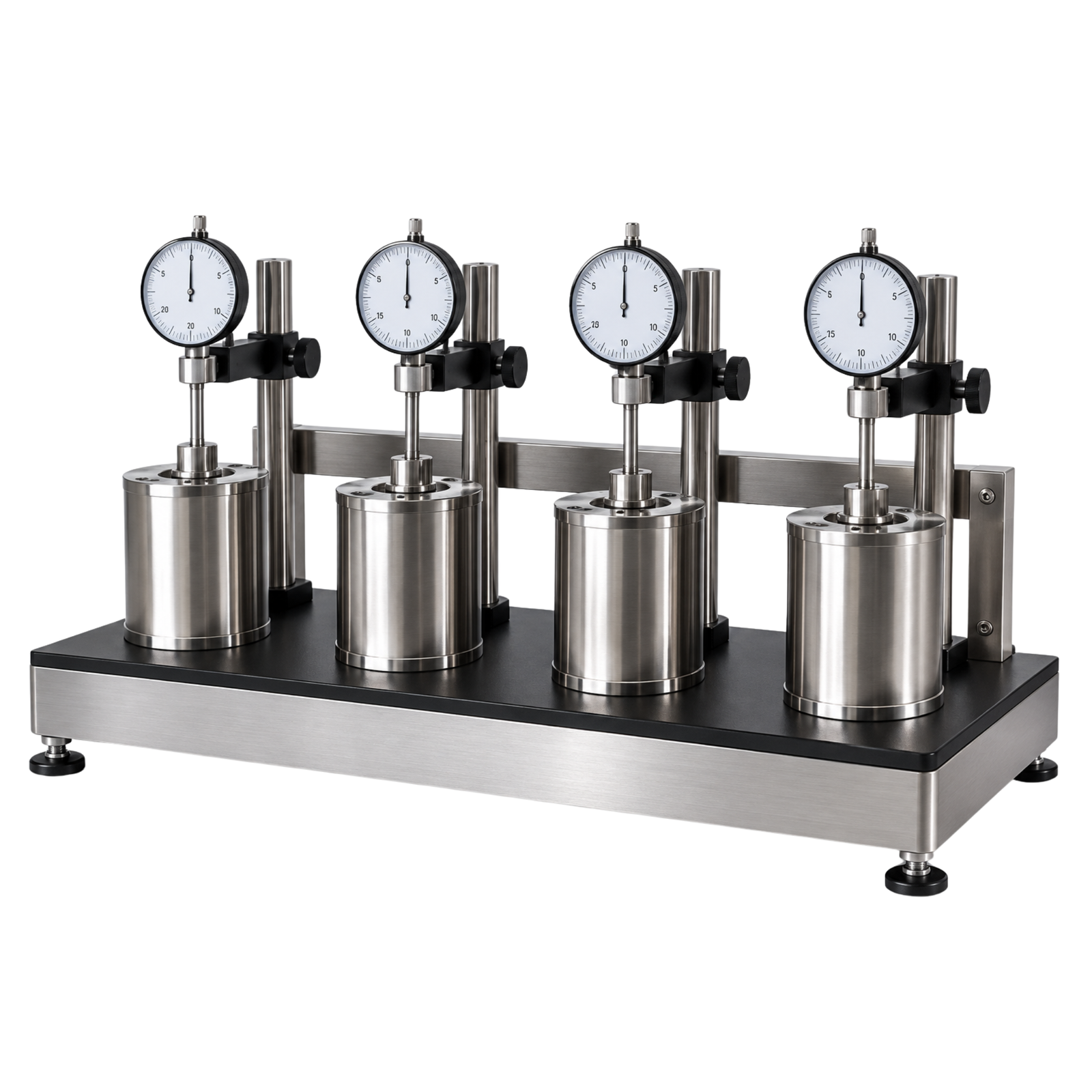
Figure 11. Reference photograph of the Atmospheric Swell Meter (4-Ch), showing the four independent LVDT gauges, cells and support frame. Components are listed on page 2.
Intended applications
• Screening four inhibitor formulations against the same shale simultaneously.
• Running replicates for statistically meaningful comparison.
• Comparing a control fluid with three treated fluids.
• Batch qualification of clay or shale materials
FEATURES
• Four independent cells and LVDT sensors on a common frame.
• Multi-channel display and logging of all four channels.
• Identical wafer holders and cups for consistent results.
• Compact footprint for the laboratory bench.
• Easy loading and cleaning of each cell.
TECHNICAL SPECIFICATIONS
| Channels | 4 independent LVDT cells |
| Sample (Each) | Compacted wafer, typically about 25 mm diameter x 6 mm thick |
| Test Conditions | Ambient temperature and atmospheric pressure |
| Test Duration | Typically 2-24 hours, per laboratory SOP |
| Measured Value | Linear swell, % of initial height |
| Data Output | Multi-channel readout with logging |
| Application | High-throughput screening |
Main components (see Figure 11)
| No. | Component |
| 1 | Support frame and rail |
| 2 | Four LVDT sensors |
| 3 | Multi-channel readout |
| 4 | Sample wafers |
| 5 | Four fluid cups |
| 6 | Base plate |
Principle of operation
Basic operating procedure
1. Prepare four wafers of equal mass compacted at the same pressure and dwell time.
2. Place each wafer in its holder and cup, lower each LVDT rod and zero all channels.
3. Fill the cups with the four test fluids and start logging on all channels.
4. Monitor the four swell curves at fixed intervals.
5. At the end of the test stop logging and remove the fluids.
6. Clean all cells, export the data and report swell percentage against time for each fluid.
Calibration and maintenance
• Zero-check and linearity-check each LVDT channel regularly.
• Clean the wafer holders and cups after every test.
• Keep the rods free of deposits and check for straightness.
• Inspect cabling and connections.
Safety precautions
• Wear a dust mask when grinding and compacting shale.
• Use gloves and eye protection with chemical inhibitors.
• Dispose of used fluids per site rules.
Reference sources
• US Patent 5,110,484 (LVDT swelling tests with compacted clay wafers)
• ISO/NP 26652, linear swelling ratio of shale using a dilatometer (under development)
• OFITE linear swell meter product literature