
MUD TESTING EQUIPMENT
For years, Inmotion Energy has supplied
precision instruments and drilling tools for
testing drilling fluids, well cements, and
completion fluids.
From our Bangalore facility, we provide
customers across India and the Middle East
with quality products and exceptional
service.
INDUSTRIES WE SERVE
— Onshore & offshore drilling contractors
— National & independent oil companies
— Mud engineering & testing laboratories
— Well completion & workover operations
WHY CHOOSE US
— Rigorous quality control on every unit
— Fast turnaround on spares &
replacements
— Field-tested designs, built for uptime
INMOTION ENERGY (OPC) PRIVATE LIMITED
- 186, 1st Main Road, Vijaya Bank Layout, Bilekahalli, Bangalore, Karnataka – 560076
- Phone: +91 96637 44619
- info@inmotionenergy.in
- imotion.in
PRODUCT SPECIFICATION — Differential Sticking Tester
Model: IM-DST-NF2 Compliance / target standard: Wellbore Adhesion Analysis
Differential Sticking Tester
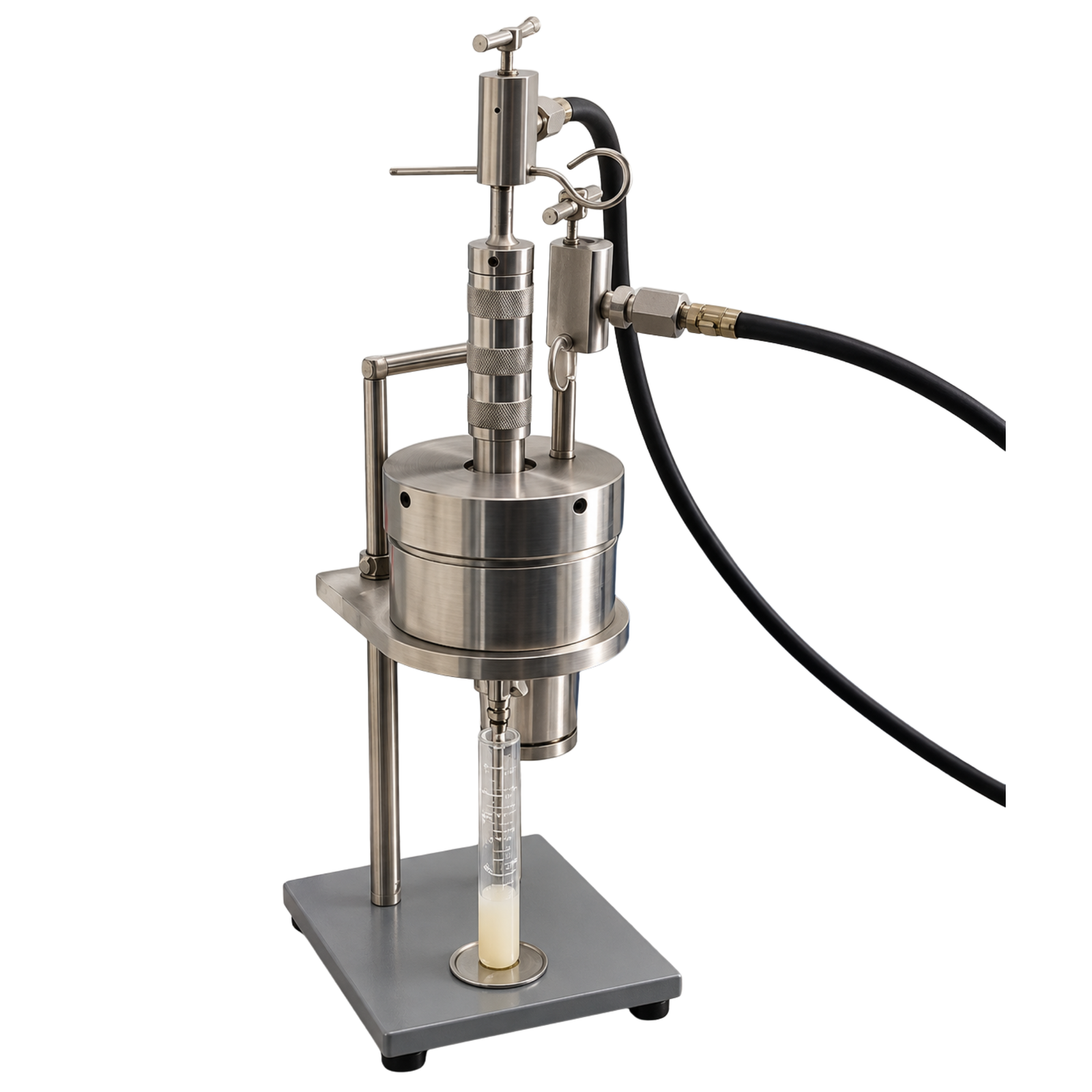
Figure 13. Reference photograph of the Differential Sticking Tester, with the pressure cell mounted for mud-cake formation. Components are listed on page 2.
Intended applications
• Comparing the sticking tendency of different mud formulations.
• Evaluating lubricants, filtration-control agents and weighting materials.
• Testing the effectiveness of spotting fluids (pipe release agents).
• Well planning for depleted or high-overbalance intervals.
FEATURES
• Pressure cell of about 200 mL capacity with N2 supply and gauge.
• Flat torque plate and a spherical-radius plate representing pipe or collar contact.
• Torque handle and shaft for timed sticking measurements.
• Bottom drain valve for filtrate collection.
• Stainless steel construction.
TECHNICAL SPECIFICATIONS
| Standard test pressure | About 477.5 psi (3,292 kPa) differential |
| Cell capacity | About 200 mL, stainless steel |
| Torque plates | Flat-faced plate; spherical plate (12.5 in radius) |
| Pressure source | Nitrogen |
| Measurement | Torque required to turn the plate after a timed stick period |
| Result | Stuck-tendency coefficient |
| Related equation | Sticking force = differential pressure × contact area × friction coefficient |
Main components (see Figure 1)
| No. | Component |
| 1 | Torque handle |
| 2 | Pressure gauge |
| 3 | Shaft |
| 4 | Pressure cell |
| 5 | Torque plate and filter medium |
| 6 | Base and drain valve |
Principle of operation
Basic operating procedure
1. Place the filter medium in the cell, fill with mud and fit the lid.
2. Apply the test pressure (about 477.5 psi) and allow a filter cake to form for the specified time.
3. Position the torque plate against the cake so that it is embedded under differential pressure.
4. Wait for the specified stick time, then turn the handle with a torque wrench and record the peak torque.
5. Vent pressure, drain the cell and remove the plate and cake.
6. Calculate and report the stuck-tendency coefficient; clean the cell thoroughly
Calibration and maintenance
• Inspect O-rings, plates and the filter support for wear.
• Calibrate the torque wrench and pressure gauge annually.
• Clean the cell and plate immediately after use; avoid scratching surfaces.
• Lubricate threads and check the drain valve.
Safety precautions
• The cell is pressurised: vent fully before opening.
• Wear eye protection and gloves.
• Use nitrogen only and secure the cylinder.
Reference sources
• OFITE Model 150-50 Differential Sticking Tester instruction manual
• Industry literature on differential pressure sticking (sticking force = differential pressure x contact area x friction coefficient)
• US Patents 4,829,816 and 5,555,937 (testing and releasing differentially stuck pipe)