
MUD TESTING EQUIPMENT
For years, Inmotion Energy has supplied
precision instruments and drilling tools for
testing drilling fluids, well cements, and
completion fluids.
From our Bangalore facility, we provide
customers across India and the Middle East
with quality products and exceptional
service.
INDUSTRIES WE SERVE
— Onshore & offshore drilling contractors
— National & independent oil companies
— Mud engineering & testing laboratories
— Well completion & workover operations
WHY CHOOSE US
— Rigorous quality control on every unit
— Fast turnaround on spares &
replacements
— Field-tested designs, built for uptime
INMOTION ENERGY (OPC) PRIVATE LIMITED
- 186, 1st Main Road, Vijaya Bank Layout, Bilekahalli, Bangalore, Karnataka – 560076
- Phone: +91 96637 44619
- info@inmotionenergy.in
- imotion.in
PRODUCT SPECIFICATION — Single-Cell LPLT Filter Press (CO2)
Model: IM-FP-LPLT2C Compliance / target standard: Field/Rig Portable Testing
Single-Cell LPLT Filter Press (CO2)
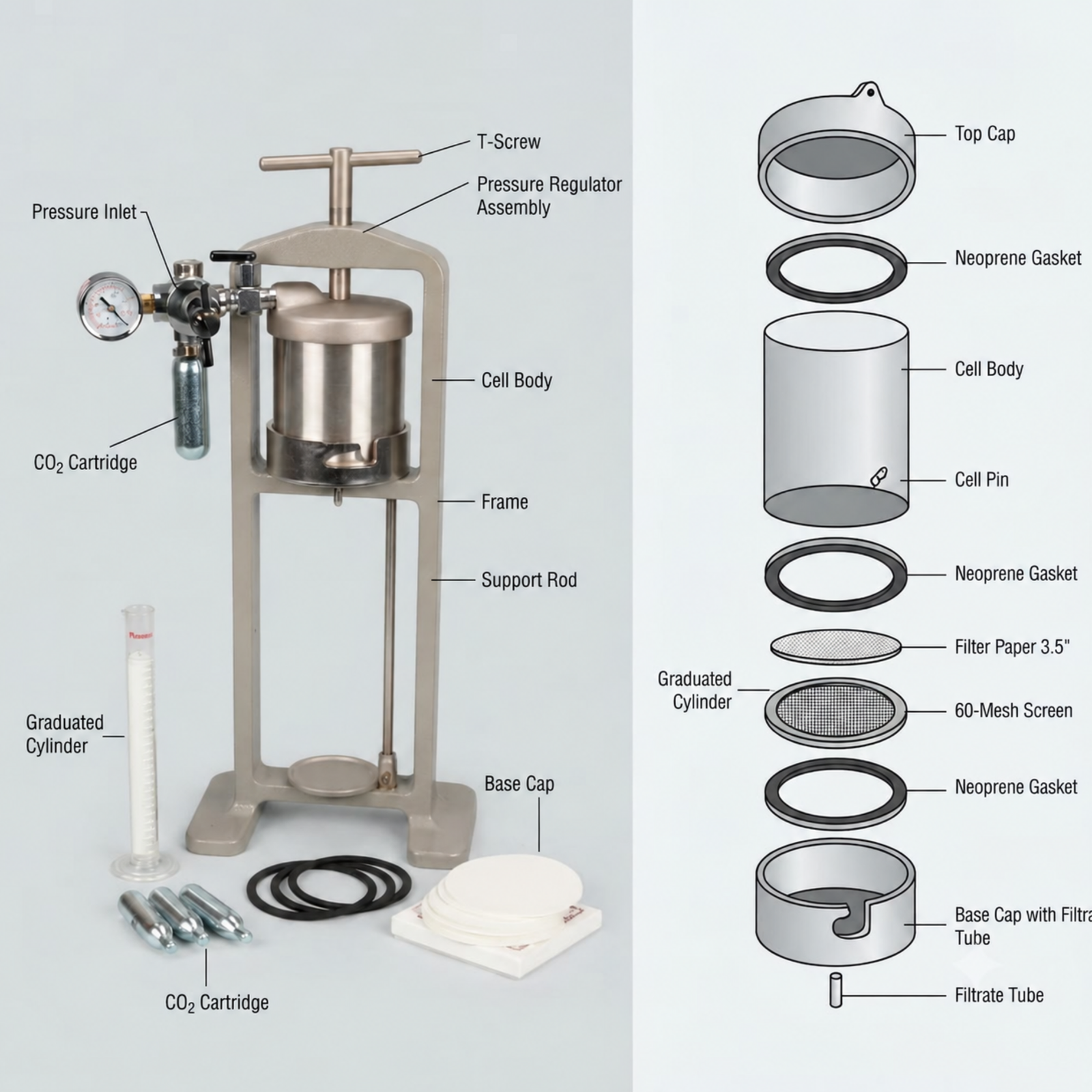
Figure 3. Single-Cell LPLT Filter Press (CO2) (reference photograph). Components are listed on page 2.
Intended applications
• Routine API filtrate (fluid loss) and cake-thickness checks at the rig.
• Monitoring the effect of fluid-loss additives such as starch, PAC and CMC.
• Collecting filtrate for chloride, alkalinity, hardness and Garrett Gas Train tests.
• Quick comparison of mud samples in the field lab.
FEATURES
• CO2-cartridge pressure source with regulator and gauge; no external gas supply.
• Standard API 7.1 in2 filter area with quick-release T-screw frame.
• Corrosion-resistant cell with O-ring seals for repeatable sealing.
• Compact, portable format suitable for rig-site cases.
• Graduated cylinder for direct filtrate reading.
TECHNICAL SPECIFICATIONS
| Test Pressure | 100 +/- 5 psi (690 +/- 35 kPa) |
| Test Duration | 30 minutes |
| Filter Area | 7.1 +/- 0.1 in² (4580 +/- 60 mm²) |
| Cell Dimensions | Inside diameter about 76.2 mm; height at least 64 mm |
| Filter Medium | Hardened filter paper, 90 mm (e.g. Whatman No. 50 or equal) |
| Pressure Source | Regulated CO2 cartridge (12 g) |
| Filtrate Receiver | 10 or 25 mL graduated cylinder |
Main components (see Figure 3)
| No. | Component |
| 1 | T-screw and frame arm |
| 2 | Pressure hose |
| 3 | CO2 cartridge and regulator |
| 4 | Filter cell |
| 5 | Frame post and base |
| 6 | Graduated cylinder |
Principle of operation
Basic operating procedure
1. Assemble the dry cell: base cap, screen, filter paper and gasket in that order.
2. Fill the cell with mud to about 6 mm below the top; fit the top cap and secure in the frame.
3. Place a dry graduated cylinder under the drain tube; close the relief valve.
4. Apply 100 psi within 30 seconds and start the timer.
5. At 30 minutes record the filtrate volume, then shut off pressure and open the relief valve.
6. Release pressure, remove the cell carefully, wash the cake lightly and measure its thickness (1/32 in or mm);
report both values.
Calibration and maintenance
• Inspect O-rings, gaskets and the screen before each test; replace when worn.
• Check the regulator, gauge and hose for leaks; verify the gauge against a reference.
• Rinse and dry all parts after use; store dry.
• Use only cartridges rated for the regulator.
Safety precautions
• The cell is under pressure; always relieve pressure before opening.
• Keep CO2 cartridges away from heat and never puncture them by hand.
• Wear eye protection and gloves when handling mud.
Reference sources
• API RP 13B-1 / ISO 10414-1, Field Testing of Water-Based Drilling Fluids (filtration section)
• OFITE low-pressure filter press product literature
• Fann API low-pressure filter press instruction manual
• ISO 10414-1:2008